
PHILANTHROPIA: THE PRACTICE OF LOVE

Author’s Note:
At a certain point, you step forward to tell your own story and let what you built stand on its own. Now is that time.
For a long time, this space carried both my writing and the work of P.S.314. That work now has a different home in a quarterly newsletter, The Collective, written for and by people who do this work.
I am here as a writer, following the questions that do not resolve easily, the ones that remain unspoken.
This is one of them.
These days, I find myself looking up words. Even the ones I have used for years.
Most of us do not learn language by choosing it with intention. We inherit it, absorbing meaning through repetition, the rooms we have sat in, and institutions that taught us what a word was supposed to signal long before we thought to ask what it actually meant.
We speak with certainty because the people around us do. But often the root is carrying something older, more precise, and revealing than the version we have been handed.
That is what happened when I returned to the word philanthropy.
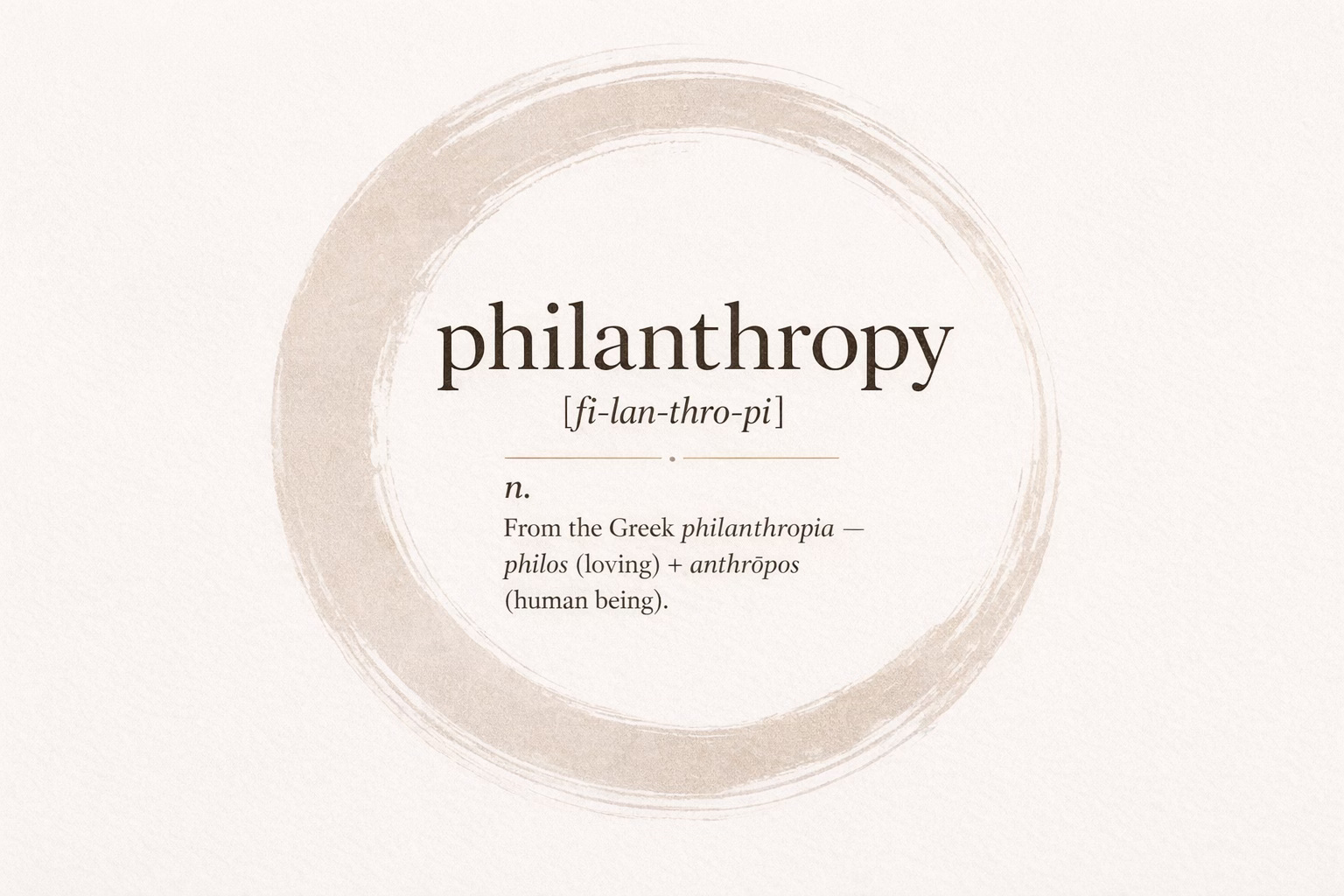
phi·lan·thro·py (fɪˈlæn.θrə.pi) n. From the Greek philanthropia — philos (loving) + anthrōpos (human being).
Meaning the love of humanity, not the funding of it or the management of its problems, but the love itself.
love (lʌv) n. From the Old English lufu — care, affection, deep attachment. From the Proto-Germanic lubō — to hold dear, to be devoted.
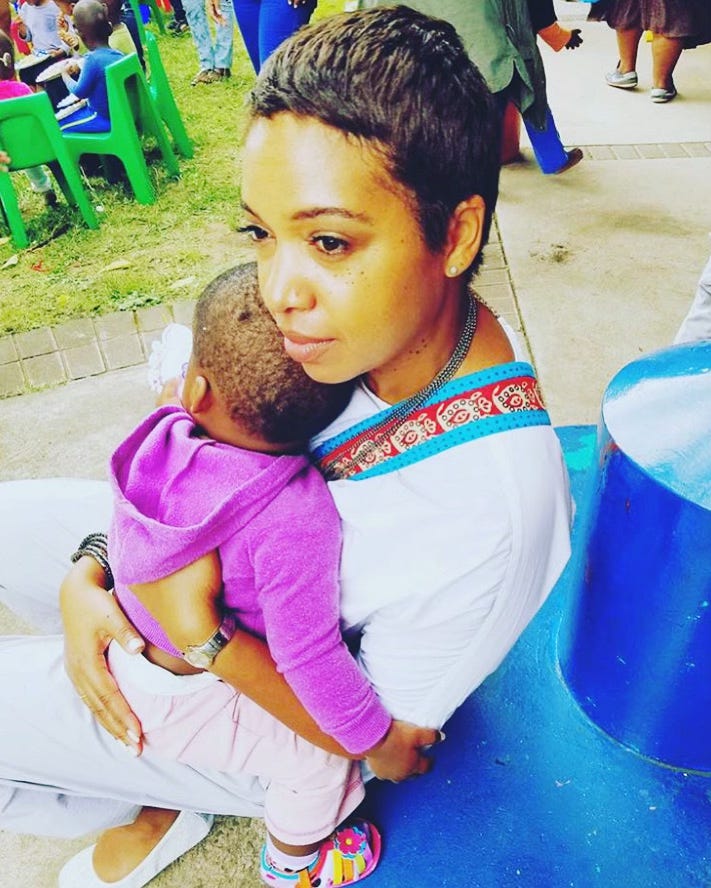
There is a picture that finds me from time to time. A small moment with a baby from a trip to South Africa many years ago. It was a mix of mission and exploration, and one morning we visited an orphanage where many of the children had no recorded birthdates. So we chose a day and celebrated all of them at once.
At some point I found myself seated, holding a baby. To comfort her, maybe. But it was comforting to me too. There is something about holding a baby. When I see the photo, I think about that feeling. What it means to hold and to be held. How rarely we make space for that kind of exchange.
And even now, as I write this, I know she did not choose to be part of this story. Her presence is helping me understand something she will never know she offered. I include her anyway. And I am still learning what it means to share something that was not mine alone.
That is exactly what this essay is about.
To love, by its oldest root, is to draw near. Devotion requires presence. It asks you to stay. You cannot be devoted from a distance or fit it into a fiscal year. It is not a line item. If that is true, what are we doing, and why does it so rarely feel like care, dignity, or being seen?
Philanthropy, as we practice it, is a transaction. Someone asks. Someone gives. Resources move in one direction and gratitude in the other.
We built systems that allow us to engage without proximity, to give without relationship, to measure impact without ever sitting in the lived reality of the people we set out to serve.
We optimized for efficiency, for scale, for metrics that translate neatly into reports. But love does not compress that easily. What we practice is well-resourced. It is also often disconnected from the very humanity it was meant to honor.
Our humanity lives in both directions, giving and asking. We are comfortable with one and uneasy with the other. Sit with that long enough, and it reveals what we avoid. We have confused needing help with being less, shaped by an unspoken belief that we give from above and receive from below.
I have felt this in both directions. I have seen it too. Then one afternoon, across a lunch table, the whole system introduced itself.

I was sitting across from a funder, discussing the prospect of his support for a Black arts organization. At the end of the meal, he leaned across the table and asked me,
“Why don’t you people support your own? We do!”
It was inappropriate as hell. And also honest in its language and its power.
He asked from the side of the table that gets to ask. I answered from the side that has to.
That is how the dynamic works. He could afford not to know the history. I could not afford to leave it unexplained. So I did what the sector trains people like me to do. I educated him. Calmly. Thoroughly. As if the question had been innocent. As if we were equals at that table. As if his not knowing were simply an oversight rather than a consequence of the same systems I was about to describe.
That is what the system looks and feels like up close. He could afford to be uninformed, to lean back, to ask anything. I was left with the labor of staying composed, leaning in prepared, responsible for the explanation. I could not afford the wrong answer.
I told him about the millionaires who had existed in thriving Black communities. About dollars reinvested forty times before leaving. About Tulsa, where a prosperous Black neighborhood was bombed from the air and burned to the ground in a single night. About Rosewood, burned and destroyed until nothing remained. About the systematic dismantling of Black wealth through redlining, urban renewal, and eminent domain, by the same government systems that protected and grew his community’s ability to give.
He nodded. I don't know what he heard.
The difference was never about commitment to community. It was about which communities were allowed to accumulate wealth and pass it forward, and which were deliberately destroyed every time they tried.
It made me think about my grandfather. His family’s land and belongings seized after the Klan killed his father on Christmas Day. Who would they have become? What would they have built? What would they have given?
I think about those questions often.
That history is in the air we breathe. It shapes who sits on which side of the table. Who gives and who asks. Who is trusted with resources, and who has to document their worthiness to receive them. We do not always name it in the rooms where philanthropy gets decided. But it is always there.

We say we are building a better society. But what created the one we have is part of the work too.
If you have ever supported a friend’s project, given in a moment of crisis, put something in the offering plate, or made sure someone in your community didn’t go without, you are a philanthropist.
The form changes, but the exchange is the same.
We are all in it. Giving formally and informally, personally and professionally, in institutions and in community. People built organizations, raised money, and took on the work of filling what was left uncovered.
This work did not emerge from generosity alone. It emerged from absence. Government built a society and left whole communities out of the cost of maintaining it. The sector stepped into that gap, not always by choice, but because the need was real and the public system was not coming. After-school programs, housing, health, and arts education. These are not charity; they are the conditions for a functioning society, transferred to a donation model and handed to organizations that run on goodwill and quarterly grants.
That is the first weight. The second is that this sector, doing work the public system abandoned, is still operating inside the same culture that created the abandonment. The same beliefs about worth. The same hierarchies of power. The same distance between those who decide and those who are affected by those decisions.
We did not step outside the system when we stepped into the gap. We brought it with us. We have built a system dependent on voluntary giving, chronically under-resourced, and unevenly distributed across the communities that need it most. With the best of intentions, we have learned to meet the metrics for success, but not the conditions for change.

This conversation belongs to all of us.
The cashier asks if you want to round up your total to donate to charity. You say yes without thinking. It takes a second. It feels like the right thing to do. But have you ever wondered where that money goes? Who decides which causes are chosen, who benefits, and what values shape those decisions?
You didn’t choose the cause. You trusted the system that chose it for you. These decisions are made every day, whether in boardrooms, grant portals, or checkout counters, often alone, quickly, and without full visibility. At a distance.
The distance allows us to give, respond to an ask, or address a crisis, but proximity is what keeps us accountable. Close enough to see what that giving actually does. And it is also where we begin to see the cost of its absence.
We have all seen it. The disaster appeal that shows only suffering, never survival. The campaign built on pity rather than possibility. The story told about someone rather than with them. This is not an exception to the system. It is how the system works.
When someone’s story is used to open a donor’s wallet, but they had no say in how it was told, what was included, what was left out, whose comfort it was written for, their pain becomes the product. Their power stays invisible.
I have been on both sides of this. I have held the baby and written the story she did not choose to be in. I have sat across the table from a man who leaned back while I leaned in, carrying history he did not have to know, performing composure I did not feel. I have been the one with the pen and the one without the power. I know what both feel like. The system shaped both moments.
That is not an exception. That is the system, working through me. And it does not leave you just because you know better. Awareness does not equate to escape.
And all too often, asking for help comes with a cost.
Forty hours of documentation for a grant that will fund twenty. An application designed for an organization ten times your size, filled out anyway because the need is real. The help arrives wrapped in homework, shaped by someone who has rarely sat in the room where the work actually happens.
When resources do arrive, they often reflect someone else’s priorities. Close to right, but not quite. And over time, without anyone deciding it outright, the work begins to orient itself toward the money rather than the need it was meant to address.
Distance does that. It shifts the center of gravity. From the community to the funder. From the mission to the metrics. From relationship to compliance.
This is not an indictment of people. The care is there, but the systems we participate in pull us away from the change we say we want. The architecture is the problem. It’s the system that breaks the connection between intention and outcome.

The line between nonprofit and for-profit is not as clear as we tell ourselves it is.
Both rely on revenue: one from sales, the other from charity and philanthropy. But both answer to someone with the power to determine their survival. Both manage people, measure performance, and make decisions about whose needs are prioritized and whose are deferred.
The difference is supposed to live in the intention, the mission, the devotion. But we brought the same culture with us. The same beliefs about worth and leadership. The same assumptions about who is trusted and who must prove themselves. The money moved through those beliefs. The structures reflected them. At what point does the mission become the story we tell rather than the system we have built?
We named this thing after love. And then we built it to keep love out.
If the funds supporting young people come from a company whose products are making those same children sick, do you take it?
If the capital behind your work was built on the extraction of resources from the communities you serve, do you accept it?
If good intentions and harmful systems coexist, what are we actually sustaining?
What is good money?

There is a story we tell about philanthropy. That it is the good money, that when capital moves toward the greater good it becomes something different. Something cleaner. That the sector built around it is exempt from what built it. That intention redeems the source and mission separates us from the market.
But we have seen what that story costs. We have seen who pays for it.
No money arrives without history. It moves through the same systems that created the conditions we are trying to change. We assumed intention would be enough to make a difference, to build the culture and civil society we say we want. It is not, and has never been, enough. What would be true is a practice built from the root. Not just moving money but staying present to what it touches. Not just giving but understanding what giving actually constructs, who it serves, and whether it is building anything close to the society it was named for.
The love of humanity is a way of building. And we have not yet built what the word asked of us.
What makes money good is not simply where it comes from. It is what it demands of the people who move it, and whether they are willing to meet that demand. For the investment to reflect the work, the investor must be in relationship with it. Not just funding or measuring it, but actually present to it. Close enough to understand what the community needs rather than what the report requires. Willing to be accountable not just for what they gave but for what it produced and what it cost.
That requires something different from both sides of the table. The sector that holds capital has to move toward partnership rather than patronage. And the sector that receives it has to stop performing worthiness and start demanding mutuality.
This is where the meaning lives. Not in the money itself but in what we are willing to build around it.
If philanthropy is the love of humanity, then giving is a practice of love. And love requires more than intention. It requires presence, proximity, and the honesty to ask what it costs and where it comes from.
These are honest questions we are all, at our best, still learning to ask. They are not separate from how I live and work. I make trade-offs. I participate in systems I question. I don’t always get it right. I’m still asking them, right alongside you.
I’m Pi-Isis S. Ankhra, writer and strategist exploring power, change, community, and identity. If this piece stayed with you, share it with someone who might need the question.